Publikationen
Publikationen 2026:
-
Berger, S., Ripsam, M., Nerdel, C., Fischer, F., & Gräsel, C. (2026) Professional learning communities: a case study on conditions and processes of collaboration. Learning: Research and Practice, 1-22. https://doi.org/10.1080/23735082.2026.2742929
-
Markic, S., Naumann, L., & Ripsam, M. (2026). Job Shadowing Across Boundaries: Collaborative Learning between Chemistry Pre- and In-Service Teachers. Science Education International, 27(3), 297-306. https://www.icaseonline.net/journal/index.php/sei/article/view/1904
-
Ripsam, M., & Nerdel, C. (2026). Selbsteinschätzung des medienbezogenen Professionswissens, der Einstellungen und der Selbstwirksamkeit von MINT-Lehrkräften zum Forschenden Lernen mit digitalen Medien. In K. Scheiter, D. Richter, D. Pittich, & L. Halbrock (Hrsg.), Professionelles Handeln in einer Kultur der Digitalität: Ergebnisse aus dem Kompetenzzentrum MINT (Teilband 1, S. 353–367). Waxmann. https://doi.org/10.31244/9783818851507
-
Memmen, J., Markic, S. CHEMKON. 2026; 0, e70024. https://doi-org.emedien.ub.uni-muenchen.de/10.1002/ckon.70024
-
Markic, S. (2026). Chemish: The Evolution of the Language of Chemistry. https://doi.org/10.1016/B978-0-323-95504-1.01002-4
-
Nascimento, M.M., Markic, S. (2026). Practical Work in Science Education: Foundations, Challenges, and Future Perspectives. In: Leite, L., Dourado, L., Afonso, A.S., Morgado, S., Carvalho, L. (eds) Practical Work in Science Education in the Digital Era. Advances in Technology-Rich Science Education, vol 2. Springer, Cham. https://doi.org/10.1007/978-3-032-13788-3_2
-
Ripsam, M., & Nerdel, C. (2026). STEM teachers’ self-assessed professional knowledge, attitudes, and self-efficacy for context-oriented, inquiry-based teaching with digital media. Frontiers in Education, 11:1755569. https://doi.org/10.3389/feduc.2026.1755569
-
Naumann, L., & Markic, S. (2026). AI and inclusion for future chemistry teachers: a seminar approach. Chemistry Teacher International. XX-XXX. https://doi.org/10.1515/cti-2025-0104
Publikationen 2025:
-
Markic, S., & Küsel, J. (2025). Digitalisierung als Chance zu einer inklusiven Hochschullehre am Beispiel der Chemiedidaktik. In: Schultz-Pernice, F., Berger, S., Mausz, I. (eds) Digitale und analoge Lehre an der Hochschule: das Beste aus beiden Welten. Springer, Berlin, Heidelberg. https://doi.org/10.1007/978-3-662-71898-8_5
-
Markic, S. (2025). Wir verstehen Naturwissenschaften: Sprachsensible Experimentiernachmittage für Eltern und Schüler:innen als außerschulische Lernangebote. In V. B. Georgi & Y. Karakasoglu (Hrsg.), Unterricht migrationssensibel gestalten: Diskriminierungskritische Fachdidaktiken (S. 68–78). Kohlhammer.
-
Naumann, L., Mayr, J. L., & Markic, S. (2025). Between Acceptance and Scepticism: An Investigation into Secondary School Students' Attitudes toward Artificial Intelligence in Chemistry Education. Chimia, 79(10), 693-697. https://doi.org/10.2533/chimia.2025.693
-
Naumann, L., & Markic, S. (2025). Enhancing Diversity and Inclusion in Science Teacher Education: Insights from a Diagnostic Study. Journal of Chemical Education. https://doi.org/10.1021/acs.jchemed.5c00776
- Memmen, J., & Markic, S. (2025). Codesigning Learning for the Future: Participatory Development of a Student Laboratory to Promote Transversal Skills. Journal of Chemical Education, 102(10), 4278-4288.
https://doi.org/10.1021/acs.jchemed.5c00748 - Monteiro Nascimento, M., & Markic, S. (2025). The iceberg of science identity: structural inequalities in science-related practices and dispositions. International Journal of Science Education, 1-18. https://doi.org/10.1080/09500693.2025.2517890

Publikationen 2024:
- Fung, F., Markic, S., Mamlok-Naaman, R., Cesa, M. & Chiu, M. (2024). Analyzing the existing programs on promoting women scientists chemistry. Chemistry Teacher International. https://doi.org/10.1515/cti-2024-0076
- Rüschenpöhler, L., Schneider, M., & Markic, S. (2024). Secondary School Teachers' Beliefs about the Role of Culture in Chemistry Class and Their Ways of Considering and Engaging in It. Journal of Chemical Education, XX(X), XXX-XXX.
- https://doi.org/10.1021/acs.jchemed.4c00404
- Rüschenpöhler, L., Gong, X., Wang, C., & Markic, S. (2024). Secondary school students’ attitudes towards chemistry: a cultural comparison between Germany and China. International Journal of Science Education, 1–20.
https://doi.org/10.1080/09500693.2024.2365461 - Markic, S. (2024). Diversity in Science Towards Social Inclusion., Center for Educational Policy Studies Journal, 14(1), 7-11.
DOI:https://doi.org/10.26529/cepsj.14. - Kieferle, S., & Markic, S. (2024). Language Support in a Student Laboratory for Chemistry in Secondary School., Center for Educational Policy Studies Journal, 14(1), 33-53. https://doi.org/10.26529/cepsj.1605
- Küsel, J., & Markic, S. (2024). Participatory Action Research in the Development of Higher Education with Digital Media., Action Research and Innovation in Science Education, 5(1), 7-12. https://doi.org/10.51724/arise.55
- Kieferle, S., Devetak, I., Essex, J., Hayes, S., Stojanovska, M., Mamlok-Naaman, R., & Markic, S. (2024), A Rising Tide Lifts All Boats? The Model of Differentiation As a Tool for Diversity in Science toward Social Inclusion., Journal of Chemical Education, 103(1). DOI: 10.1021/acs.jchemed.3c00550
- Kieferle, S., & Markic, S. (2024). Enabling active participation and inquiry‐based learning–inclusive learning settings for a student laboratory for lower secondary school. CHEMKON, 31(1), 21-27.
DOI: 10.1039/D3RP00140G
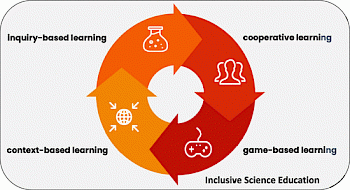
Abb. 1.: The DiSSI approach of inclusive science education
Publikationen 2023:
- Mönch, C., & Markic, S. (2023). Development, Implementation, and Evaluation of a Pre-service Chemistry Teacher Preparation Unit on Fostering Pedagogical Scientific Language Knowledge. Journal of Chemical Education, 100(9), 3228-3239.
https://pubs.acs.org/doi/10.1021/acs.jchemed.2c01222 - Mönch, C., & Markic, S. (2023). Elements constituting and influencing in-service secondary chemistry teachers’ pedagogical scientific language knowledge. Chemistry Education Research and Practice, 25(1). DOI: 10.1039/d3rp00140g
- Kieferle, S., & Markic, S. (2023).Enabling active participation and inquiry‐based learning – inclusive learning settings for a student laboratory for lower secondary school. CHEMKON, 31(3). DOI: 10.1002/ckon.202300015
- Kieferle, S., & Markic, S. (2023). Development and implementation of innovative concepts for language-sensitive student laboratories. Chemistry Education Research and Practice, 24(2), 740-753.
DOI: 10.1039/D2RP00221C - Küsel, J., Martin, F., Markic, S., Byker, E. J., & Polly, D. (2023). Investigating US and German pre-service teachers’ beliefs regarding digital technology. Compare: A Journal of Comparative and International Education, 1-19.
https://doi.org/10.1080/03057925.2023.2268518 - Kieferle, S., & Markic, S. (2023). Aktive Teilhabe und Forschendes Lernen ermöglichen–inklusive Lernumgebungen im SchülerInnenlabor der Sekundarstufe I (No. CHEMKON 2023, 30). Wiley Online Library.
https://doi.org/10.1002/ckon.202300015
Publikationen vor 2023:
- Šojat, L., & Markic. S. (2022). Starting the Educational Reform from the Beginning: Croatian Pre-Service Chemistry Teachers’ Level of Pedagogical Content Knowledge on Particle Theory. Education Sciences, 12(12). DOI: 10.3390/educsci12120907
- Mönch, C., & Markic, S. (2022). Science Teachers’ Pedagogical Scientific Language Knowledge—A Systematic Review. Education Sciences, 12(7):497. DOI: 10.3390/educsci12070497
- Mönch, C., & Markic, S. (2022). Exploring Pre-Service Chemistry Teachers’ Pedagogical Scientific Language Knowledge. Education Sciences, 12(4):244. DOI: 10.3390/educsci12040244
- Rüschenpöhler, L., Zeller, M., Küsel, J., & Markic, S. (2022). Die Bildung von Coaches für eine diversitysensible Berufsorientierung in den Naturwissenschaften. Diversitätssensible Berufsorientierung in den Naturwissenschaften: Einblicke in DiSenSu. Universität Darmstadt.
- Rüschenpöhler, L., Zeller, M., Küsel, J., & Markic, S. (2022). Die Einbindung von Eltern in die naturwissenschaftliche Berufsorientierung von Mädchen mit Migrationshintergrund. Diversitätssensible Berufsorientierung in den Naturwissenschaften: Einblicke in DiSenSu. Universität Darmstadt.
- Rüschenpöhler, L., Zeller, M., Küsel, J., & Markic, S. (2022). Nachhaltigkeit und Auswirkung der DiSenSu-Berufsorientierungschoachings. Diversitätssensible Berufsorientierung in den Naturwissenschaften: Einblicke in DiSenSu. Universität Darmstadt.
- Rüschenpöhler, L., Zeller, M., Küsel, J., & Markic, S. (2022). Networking im Projekt DiSenSu: Der erfolgreiche Aufbau eines Netzwerks für die naturwissenschaftliche Berufsorientierung und Organisation der Events. Diversitätssensible Berufsorientierung in den Naturwissenschaften: Einblicke in DiSenSu. Universität Darmstadt.
- Mönch, C., & Markic, S. (2022, Mai). Pedagogical Scientific Language Knowledge angehender Chemielehrkräfte. Gesellschaft für Didaktik der Physik und Chemie. Virtuelle Jahrestagung 2021.
- Küsel, J., Zeller, M., Rüschenpöhler, L., & Markic, S. (2021). Berufsorientierung zu chemischen Berufen: Ein vernachlässigter Bereich der Bildung von Lehrer:innen. CHEMKON, 30(1). DOI: 10.1002/ckon.202100029
- Zeller, M., Rüschenpöhler, L.,Küsel, J., & Markic, S. (2021). Coaching strategies in vocational orientation for promoting young women’s self-concept and career aspirations in chemistry. Chemistry Teacher International, 3(4). DOI: 10.1515/cti-2021-0006
- Rüschenpöhler, L., & Markic, S. (2021). Psychological Patterns in Chemistry Self-Concept: Relations with Gender and Culture. Engaging with Contemporary Challenges through Science Education Research. DOI: 10.1007/978-3-030-74490-8_13
- Mönch, C., & Markic, S. (2021, Juli). Exploring Future Chemistry Teachers’ Pedagogical Scientific Language Knowledge. Eurovariety 2021.
- Mönch, C., Martin, C., Kapanadze, M., Modebadze, N., Nuic, I., Pilic, Z., Roleda, L., Paz Morales, M., & Markic, S. (2021, Jan). ESTA – Educating Science Teachers for All. GDCP Jahrestagung 2020.
- Rüschenpöhler, L., Küsel, J., Zeller, M., & Markic, S. (2020). Assisting students in their career choices: strategies for promoting students’ science identities following the science capital approach. CHEMKON. DOI: 10.1002/ckon.202000056
- Küsel, J., Martin, F., & Markic, S. (2020). University Students` Readiness for Using Digital Media and Oline Learning-Comparison between Germany and the USA. Education Science, 10(313). DOI:10.3390/educsci10110313
- Rüschenpöhler, L., Zeller, M., Küsel, J., & Markic, S. (2020). The Role of Gender and Culture in Vocational Orientation in Science. Education Sciences, 10(9):240. DOI: 10.3390/educsci10090240
- Rüschenpöhler, L., & Markic, S. (2020). How the home environment shapes students’ perceptions of their abilities: the relation between chemistry capital at home and students’ chemistry self-concept. International Journal of Science Education, 42(12):1-20. DOI: 10.1080/09500693.2020.1812010
- Markic, S. (2020). Rachel Mamlok-Naaman, Ingo Eilks, George Bogner and Avi Hofstein: Professional Development of Chemistry Teachers – Theory and Practice, Royal Society of Chemistry: Croydon (UK), 2018, 203 pp.: ISBN: 9781782627067. Center for Educational Policy Studies Journal, 10(1)215-218. DOI: 10.26529/cepsj.904
- Markic, S. (2020). Chemistry Education in the Countries of the Former Yugoslavia. Center for Educational Policy Studies Journal, 10(1):5-8. DOI: 10.26529/cepsj.902
- Affeldt, F., Eilks, I., & Markic, S. (2020). Über die Nutzung abgestufter Lernhilfen beim forschenden Lernen.
- Rüschenpöhler, L., & Markic, S. (2020). Secondary school students’ chemistry self-concepts: Gender, culture, and the impact on learning behaviour. Chemistry Education Research and Practice, 21(1):209-219. DOI: 10.1039/C9RP00127A
- Zeller, M., Rüschenpöhler, L., Küsel, J., & Markic, S. (2020, Apr). Förderung von Science Capital im Berufsorientierungsprojekt DiSenSu. Naturwissenschaftliche Kompetenzen in der Gesellschaft von morgen. Gesellschaft für Didaktik der Chemie und Physik. Jahrestagung in Wien 2019.
- Rüschenpöhler, L., & Markic, S. (2020, Apr). Chemistry Capital: Ein Schlüssel zur Identitätsbildung. Naturwissenschaftliche Kompetenzen in der Gesellschaft von morgen. Gesellschaft für Didaktik der Chemie und Physik. Jahrestagung in Wien 2019.
- Rüschenpöhler, L., G. Schneider, M., & Markic, S. (2020, Apr). Chemie als "kulturfreie Zone"? Die Perspektive der Lehrperson. Naturwissenschaftliche Kompetenzen in der Gesellschaft von morgen. Gesellschaft für Didaktik der Chemie und Physik. Jahrestagung in Wien 2019.
- Affeldt, F., Eilks, I., & Markic, S. (2019). Students' use of graded learning aids for inquiry learning.
- Rüschenpöhler, L., & Markic, S. (2019). A Mixed Methods Approach to Culture-Sensitive Academic Self-Concept Research. Education Sciences, 9(3):240. DOI: 10.3390/educsci9030240
- Rüschenpöhler, L., & Markic, S. (2019). Current trends in science and technology self-concept research: Theoretical foundation, measurement instruments, and main findings. Studies in Science Education. DOI: 10.1080/03057267.2019.1645533
- Zeller, M., Rüschenpöhler, L., Küsel, J., & Markic, S. (2019, Jan). Berufswahl MINT: Gründe von Studierenden und SchülerInnen. GDCP 2018. Kiel, Deutschland.
- Rüschenpöhler, L., & Markic, S. (2019, Jan). Psychologische Muster in Chemie-Selbstkonzepten. GDCP 2018. Kiel, Deutschland.
- Tolsdorf, Y., & Markic, S. (2018). Entwicklung eines Seminarkonzepts zu Lesestrategien entwickelt nach dem adaptierten Modell der Partizipativen Aktionsforschung. CHEMKON, 26(3). DOI: 10.1002/ckon.201800017
- Affeldt, F., Siol, A., Eilks, I. & Markic, S. (2018). Neue Ansätze zur Differenzierung im Schülerlabor. CHEMKON, 25(7). DOI: 10.1002/ckon.201700502
- Tolsdorf, Y., & Markic, S. (2018). Development and Changes in Student Teachers´ Knowledge Concerning Diagnostic in Chemistry Teaching - A Longitudinal Case Study. Eurasia Journal of Mathematics, Science and Technology Education, 14(12). DOI: 10.29333/ejmste/94232
- Tolsdorf, Y., Kousa, P., Aksela, M., & Markic, S. (2018). Learning to Teach at Heterogeneous and Diverse Chemistry Classes - Methods for University Chemistry Teacher Training Courses. Eurasia Journal of Mathematics, Science and Technology Education, 14(10). DOI: 10.29333/ejmste/93377
- Tolsdorf, Y., & Markic, S. (2018). Participatory Action Research in University Chemistry Teacher Training. Center for Educational Policy Studies Journal, 8(4):1. DOI: 10.26529/cepsj.269
- Tolsdorf, Y., & Markic, S. (2018). Development of an instrument and evaluation patter for for the analyisis of chemistry student teachers` diagnostic competence. International Journal of Physics and Chemistry Education, 9(3):1-10. DOI: 10.12973/ijpce/80707
- Eilks, I., Ralle, B., & Markic, S. (2018). Building bridges across disciplines for transformative education and a sustainable future. Shaker.
- Rincke, K., & Markic, S. (2018). Sprache und das Lernen von Naturwissenschaften. Theorien der naturwissenschaftsdidaktischen Forschung. DOI: 10.1007/978-3-662-56320-5_3
- Markic, S. (2018). Learning Language and Intercultural Understanding in Science Classes in Germany. Global Developments in Literacy Research for Science Education. DOI: 10.1007/978-3-319-69197-8_5
- Prechtl, M., Zeller, M., Küsel, J., Rüschenpöhler, L., Stubbe, U., & Markic, S. (2018). DiSenSu: Diversity sensitive support for girls with migration background for STEM careers. Building bridges across disciplines for transformative education and a sustainable future. Shaker.
- Rüschenpöhler, L., & Markic, S. (2018). Chemistry? Not my thing! Cultural differences in students’ chemistry self-concepts. Building bridges across disciplines for transformative education and a sustainable future. Shaker.
- Tolsdorf, Y., & Markic, S. (2017). Exploring Chemistry Student Teachers’ Diagnostic Competence—A Qualitative Cross-Level Study. Education Sciences, 7(4):86. DOI: 10.3390/educsci7040086
- Wichman, J., Affeldt., F., Siol, A., Eilks, I., & Markic, S. (2017). Promoting education for sustainability for all learners by non-formal chemistry laboratories.
- Affeldt, F., Weitz, K., Eilks, I., & Markic, S. (2017). Experimentierzugänge kreativ gestalten mit Comics und sozialen Medien zum Thema „Metallische Gegenstände schützen und bewahren“.
- Abels, S., & Markic, S. (2017). Inklusion – aber wie? Methoden und Materialien aus der Praxis für die Praxis.
- Rüschenpöhler, L., & Markic, S. (2017, Jan). Kulturelle Unterschiede der Selbstkonzepte in der Chemie. GDCP 2017. Regensburg, Deutschland.
- Childs, P.E., & Markic, S. (2016). Language and the teaching and learning of chemistry. Chemistry Education Research and Practice, 17(3). DOI: 10.1039/C6RP90006B
- Affeldt, F., Siol, A., Fey, S., Huwer, J., Hempelmann, R., Urbanger, M., Tandetzke, R., Kometz, A., Beck, U., Ducci, M., Eilks, I., & Markic, S. (2016). Chemie, Umwelt und Nachhaltigkeit im Schülerlabor – Lernangebote für alle Schülerinnen und Schüler
- Mamlok-Naaman, R., Hugerat, M., Hofstein, A., Dkeidek, I., Kortam, N., Eilks, I., & Markic, S. (2016). One country, two cultures – A multi-perspective view on Israeli chemistry teachers` beliefs about teaching and learning. Teachers and Teaching: Theory and Practice, 22(2):131-147. DOI: 10.1080/13540602.2015.1055423
- Abels, S., & Markic, S. (2016). Science Education towards Inclusion. Nova Science Publsihers.
- Affeldt, F., Wichemann, J., Siol, A., Eilks, I., & Markic, S. (2016). Supporting practical science learning for all students – A German cross-country initiative in non-formal chemistry education. In Eilks, I., Ralle, B., & Markic, S. (Hrsg.), Science education research and practical work. Shaker.
- Affeldt, F., Siol, A., Eilks, I., Fey, S., Huwer, J., Hempelmann, R., Urbanger, M., Kometz, A., Beck, U., Ducci, M., & Markic, S. (2016). Schülerlaborangebote zur Umwelt- und Nachhaltigkeitsbildung für alle Schülerinnen und Schüler. In Maurer, C. (Hrsg.), Authentizität und Lernen - das Fach in der Fachdidaktik. Universität Regensburg.
- Tolsdorf, Y., & Markic, S. (2016). Language in science classrooms: Diagnosing students’ linguistic skills.
- Abels, S., & Markic, S. (2016). Science Education Meets Inclusion. In Abels, S., & Markic, S. (Hrsg.), Science Education towards Inclusion. Nova Science.
- Markic, S. (2015). Chemistry Teachers’ Attitudes and Needs When Dealing with Linguistic Heterogeneity in the Classroom. DOI: 10.1007/978-3-662-45085-7_14
- Affeldt, F., Weitz, K., Siol, A., Eilks, I., & Markic, S. (2015). A Non-Formal Student Laboratory as a Place for Innovation in Education for Sustainability for All Students. Education Sciences 5(5):238-254. DOI: 10.3390/educsci50x000x
- Maciejowska, I., Šojat, L., Sozbilir, M., Ambrogi, P., Apotheker, J., Aydin-Günbatar, S., Bernard, P., Byers, B., McCornack, L., Olufsen, M., Petrusevski, V., Stojanovska, M., Trivic, D., & Markic, S. (2015). Pre-service Training for Chemistry Teachers: A Guidebook of Good Practice. Faculty of Chemistry Jageillonian Universityin Krakow.
- Šojat, L., & Markic, S. (2015). Educational Theories and How Students Learn Chemistry: Practice what you Preach. In Maciejowska, I., & Byers, B. (Hrsg.), Pre-service Training for Chemistry Teachers: A Guidebook of Good Practice.
- E. Childs, P., C. Ryan, M., & Markic, S. (2015). The Role of Language in the Teaching and Learning of Chemistry. Chemistry Education. DOI: 10.1002/9783527679300.ch17
- Eilks, I., & Markic, S. (2015). Evaluating Drawings to Explore Chemistry Teachers’ Pedagogical Attitudes. In Kahveci, M., & Orgill, M. (Hrsg.). Affective Dimensions in Chemistry Education. Springer, Heidelberg.
- Eilks, I., & Markic, S. (2015). Student Teachers' Needs and Concerns. Encyclopedia of Science Eduaction. DOI: 10.1007/978-94-007-2150-0_253
- Mamlok-Naaman, R., Abels, S., & Markic, S. (2015). Learning about Relevance Concerning Cultural and Gender Differences in Chemistry Education. In Eilks, I., & Hofstein, A. (Hrsg.), Relevant Chemistry Education – From theory to practice. DOI: 10.1007/978-94-6300-175-5_12
- Abels, S., Adesokan, A., Puddu, S., & Markic, S. (2015, Jan). Umgang mit Diversität und Heterogenität im Chemieunterricht. Heterogenität und Diversität - Vielfalt der Voraussetzungen im naturwissenschaftlichen Unterricht. Gesellschaft für Didaktik der Chemie und Physik, Jahrestagung. Bremen.
- Markic, S. (2014). Heterogeneity and Diversity: A Growing Challenge or Enrichment for Science Education in German Schools?. Eurasia Journal of Mathematics, Science and Technology Education, 10(4):271-283. DOI: 10.12973/eurasia.2014.1082a
- Eilks, I., Al-Amoush, S., Usak, M., Erdogan, M., & Markic, S. (2014). Beliefs about chemistry teaching and learning – a comparison of teachers and student teachers beliefs from Jordan, Turkey and Germany. International Journal of Science and Mathematics Education, 12(4):767-792. DOI: 10.1007/s10763-013-9435-7
- Eilks, I., Ralle, B., & Markic, S. (2014). Science education research and education for sustainable development. Shaker, Aachen.
- Eilks, I., Hofstein, A., Oversby, J., Ralle, B., & Markic, S. (2014). Reflections on science education research focusing education for sustainable development. In Eilks, I., Ralle, B., & Markic, S. (Hrsg.), Science education research and education for sustainable development. Shaker, Aachen.
- Schindler, D., Stuckey, M., Eilks, I., Hauk, C., Jäschke-Behrend, E., Wikes, M., & Markic, S. (2014). What Should I Do with my Old Cell Phone? A Case of Collaborative Curriculum Development within PROFILES-Bremen. In Bolte, C., Holbrook, J., Mamlok-Naaman, R., & Rauch, F. (Hrsg.), Science teachers’ continuous professional development in Europe. Cases from the PROFILES Project. FU Berlin.
- Eilks, I., Ralle, B., & Markic, S. (2014, Sep). Science Education Research and Education for Sustainable Development - 22. Sommersymposium zur Chemie- und Naturwissenschaftsdidaktik. Jahrestagung der GDCP 2014. Bremen, Deutschland.
- Eilks, I., Al-Amoush, S., Usak, M., Erdogan, M., & Markic, S. (2013). Pre- and in-service teachers’ beliefs about teaching and learning chemistry in Turkey. European Journal of Teacher Education, 36(4). DOI: 10.1080/02619768.2013.807793
- Kapanadze, M., & Markic, S. (2013). A Broad View on Georgian Science Teachers´ and Science Student Teachers` Beliefs about Teaching and Learning. Eurasia Journal of Mathematics, Science and Technology Education, 9(2)(2):143-154. DOI: 10.12973/eurasia.2013.925a
- Eilks, I., & Markic, S. (2013). Potential Changes in Prospective Chemistry Teachers' Beliefs About Teaching and Learning – A Cross-Level Study. International Journal of Science and Mathematics Education, 11:979-998. DOI: 10.1007/S10763-013-9417-9
- Abels, S., & Markic, S. (2013). Umgang mit Vielfalt – Neue Perspektiven im Chemieunterricht.
- Abels, S., & Markic, S. (2013). Die Fachsprache der Chemie. Ein gemeinsames Anliegen von heterogenen Klassen.
- Broggy, J., E. Childs, P., & Markic, S. (2013). How to Deal with Linguistics Issues in Chemistry Classes. Teaching Chemistry - A Studybook. DOI: 10.1007/978-94-6209-140-5_5
- Eilks, I., Di Fuccia, D., Ralle, B, & Markic, S. (2013). Issues of Heterogeneity and Diversity in Science Education and Science Education Research. IPN.
- Mamlok-Naaman, R., Rauch, F., Fernandez, C., & Markic, S. (2013). How to Keep Myself Being a Professional Chemistry Teacher. Teaching Chemistry - A Studybook. DOI: 10.1007/978-94-6209-140-5_10
- Tastan Kirik, Ö., & Markic, S. (2012). The Self-efficacy of Pre-service Elementary Teachers Using Cooperative Learning in Science Teaching. Procedia - Social and Behavioral Sciences, 46(3):5005-5009. DOI: 10.1016/j.sbspro.2012.06.376
- Eilks, I., Al-Amoush, S., & Markic, S. (2012). Jordanian Chemistry teachers` views on teaching practices and educational reform. Chemistry Education Research and Practice, 13(3):314-324. DOI: 10.1039/C2RP20022H
- Eilks, I., Witteck, T., Di Fuccia, D., & Markic, S. (2012). Trends in Practical Work in German Science Education. Eurasia Journal of Mathematics, Science and Technology Education, 8(1):59-72. DOI: 10.12973/eurasia.2012.817a
- Eilks, I., & Markic, S. (2012). A Comparison of Student Teachers' Beliefs from Four Different Science Teaching Domains Using a Mixed Methods Design. International Journal of Science Education, 34:589-608. DOI: 10.1080/09500693.2011.608092
- Eilks, I., Di Fuccia, D., Ralle, B., & Markic, S. (2012). Issues of Heterogeneity and Diversity in Science Education and Science Education Research. Shaker.
- Garner, N., Siol, A., Eilks, I., Thöming, J., Zehren, W., Munnia, A., Huwer, J., Hempelmann, R., & Markic, S. (2012, Sep). Chemie und Nachhaltigkeit in Schule und Schülerlabor. GDCP 2012 Konferenz. Hannover, Deutschland.
- Stuckey, M., Belova, N., Hüneburg, J., Ostersehlt, D., Eilks, I., & Markic, S. (2012, Sep). „Kleidung – die zweite Haut“ - Curriculum-Entwicklung in PROFILES-Bremen. GDCP 2012 Konferenz. Oldenbrg, Deutschland.
- Al-Amoush, S., Abu-Hola, I., Eilks, I., & Markic., S. (2011). Jordanian prospective and experienced chemistry teachers’ beliefs about teaching and learning and their potential role for educational reform.
- Eilks, I., & Markic, S. (2011). Effects of a Long-Term Participatory Action Research Project on Science Teachers’ Professional Development. Eurasia Journal of Mathematics, Science and Technology Education, 7(3):2011. DOI: 10.12973/ejmste/75196
- Eilks, I., & Markic, S. (2011). Die Veränderung fachbezogener Vorstellungen angehender Chemielehrkräfte über Unterricht während der Ausbildung – eine Cross-Level Studie. CHEMKON, 18(1):14-18. DOI: 10.1002/ckon.201010140
- Kapanadze, M., Eilks, I., Janashia, S., Makashvili, M., Stuckes, M., & Markic, S. (2011, Sep). Schüleraktives und Inquiry-orientiertes Lehren und Lernen fördern im TEMPUS-Projekt SALiS. GDCP 2011 Konferenz.
- Eilks, I., Al-Amoush, S., & Markic, S. (2011, Sep). Beliefs about teaching and learning of Jordanian chemistry student teachers and experienced teachers. 9th ESERA Conference.
- Eilks, I., Janashia, S., Kapanadze, M., Stuckey, M., & Markic, S. (2011, Sep). Promoting student-active and inquiry-based science learning by the project SALiS. 9th ESERA Conference.
- Keast, S., Cooper, R., & Markic, S. (2011, Jan). Using Slowmation to Make Explicit Science Preservice Teachers' Beleifs. European Science Education Research Association Conference 2011.
- Eilks, I., & Markic, S. (2010). First-Year Science Education Student Teachers’ Beliefs about Student- and Teacher-Centeredness: Parallels and Differences between Chemistry and Other Science Teaching Domains. Journal of Chemical Education, 87(3):335-339. DOI: 10.1021/ed8000864
- S. Taber, K. et al. & Markic,S. (2010). Facilitating Effective Student Learning through Teacher Research and Innovation. Ljubljana : Faculty of Education. DOI: 10.13140/2.1.4684.9925
- Eilks, I., Gilbert, J., Holbrook, J., Pilot, A., Ralle, B., & Markic, S. (2010). Reflections on how to Promote Succesful Science Education and the Worth of Science Education Research. In Ralle, B., & Eilks, I. (Hrsg.), Promoting successful science learning – The worth of science education research. Shaker, Aachen.
- Eilks, I., Witteck, T., & Markic, S. (2010). Collaborative innovation of the science classroom by Participatory Action Research – Theory and practice in a project of implementing cooperative learning methods in chemistry education. In Valenčič Zuljan, M., & Vogrinc, J. (Hrsg.), Facilitating effective student learning through teacher research and innovation. University of Ljubljana.
- Al-Amoush, S., Eilks, I., & Markic S. (2010, Sep). Vorstellungen von Lehramtsstudierenden der Chemie im Vergleich der Länder Jordanien, Türkei und Deutschland. GDCP 2010 Konferenz. Potsdam, Deutschland. DOI: 10.13140/2.1.3257.1847
- Eilks, I., & Markic, S. (2010, Sep). Zur Entwicklung der Vorstellungen zukünftiger Chemielehrkräfte über das Lehren und Lernen – eine Cross-Level Studie. GDCP 2010 Konferenz.Potsdam, Deutschland.
- Eilks, I., & Markic, S. (2009). Vorstellungen über Lehrer- und Schülerzentriertheit von Studienanfängern in naturwissenschaftlichen Unterrichtsfächern.
- Van Driel, Prof., Dr., J., Ralle, B., Eilks, I., & Markic, S. (2009). Vorstellungen deutscher Chemielehrkräfte über die Bedeutung und Ausrichtung des Chemielernens. CHEMKON, 16(2):90-95. DOI: 10.1002/ckon.200910091
- Eilks, I., Schanze, S., Bäumer, M., & Markic, S. (2009). Cooperative learning in higher chemistry education. In Eilks, I., & Byers, B. (Hrsg.), Innovative methods for teaching and learning chemistry in higher education. RSC Publishing, London. DOI: 10.1039/BK9781847559586-00103
- Floriano, M., Reiners, C., Avitabible, G., & Markic, S. (2009). The Uniqueness of Teaching and Learning Chemistry. Innovative Methods of Teaching and Learning Chemistry in Higher Education. DOI: 10.1039/BK9781847559586-00023
- Eilks, I., Ralle, B., & Markic, S. (2009, Sep). The curriculum emphases of German chemistry teachers and their distinction concerning different types and levels of secondary schools. ESERA 2009 Conference. Istanbul, Türkei.
- Eilks, I., & Markic, S. (2009, Sep). A mixed methods approach to characterize the beliefs on science teaching and learning of freshman science student teachers from different science teaching domains. ESERA 2009 Conference. Istanbul, Türkei.
- Eilks, I., & Markic, S. (2008). A case study on German first year chemistry student teachers’ beliefs about chemistry teaching, and their comparison with student teachers from other science teaching domains. Chemistry Education Research and Practice, 9(1):25-34. DOI: 10.1039/b801288c
- Eilks, I., & Markic, S. (2008). Unterrichtsbezogene Vorstellungen von Lehramtsstudierenden der Chemie am Beginn ihres Studiums und ihre Einordnung. CHEMKON, 15(2):69-74. DOI: 10.1002/ckon.200810072
- Eilks, I., Valanides, N., & Markic, S. (2007). Developing a Tool to Evaluate Differences in Beliefs About Science Teaching and Learning Among Freshman Science Student Teachers from Different Science Teaching Domains: A Case Study. Eurasia Journal of Mathematics, Science and Technology Education, 4(3):271-286. DOI: 10.12973/ejmste/75311
- Eilks, I., & Markic, S. (2007). Vorstellungen von Lehramtsstudierenden der Physik über Physikunterricht zu Beginn ihres Studiums und ihre Einordnung.
- Eilks, I., & Markic, S. (2007). Kooperatives Lernen im Chemieunterricht. Konzipierung und Untersuchung von Unterrichtseinheiten durch Partizipative Aktionsforschung. In Reh, S., & Rabenstein, K. (Hrsg.), Kooperatives und selbständiges Arbeiten von Schülern. Verlag für Sozialwissenschaften, Wiesbaden. DOI: 10.1007/978-3-531-90418-4_11
- Eilks, I., & Markic, S. (2007). Unterrichtsbezogene Vorstellungen von Lehramtsstudierenden in den Naturwissenschaften am Beginn ihres Studiums – Eine Mixed Methods Studie. GDCP 2007 Konferenz. Essen, Deutschland.
- Eilks, I., & Markic, S. (2006). Cooperative and context-based learning on electrochemical cells in lower secondary science lessons – A project of Participatory Action Research.
- Eilks, I., Ralle, B., Pilot, A., Valanides, N., & Markic, S. (2006). Ways towards Research-based Science Teacher Education - Reflections on the Symposium.
- Eilks, I., Valanides, N., & Markic, S. (2006). Freshman student teachers’ beliefs about science teaching – A mixed methods study. In Eilks, I., & Ralle, B. (Hrsg.), Towards research-based science teacher education. Shaker, Aachen.
- Valanides, N., Eilks, I., & Markic, S. (2006, Sep). Vorstellungen von Lehramtsstudierenden in den Naturwissenschaften über Unterricht – eine Fallstudie. GDCP 2006 Konferenz. Bern, Switzerland.
- Eilks, I., & Markic, S. (2005). Kooperatives und kontextorientiertes Lernen zu Batterien und Akkumulatoren in der SI. In Welzel, M., Nohl, T., & Wellensiek, A. (Hrsg.), Didaktik der Naturwissenschaften - Quo vadis?. Logos, Berlin.
- Valanides, N., Eilks, I., & Markic, S. (200e, Sep). First-year Science Student Teachers’ Images of Science Teaching in Germany. 5th ESERA Conference. Barcelona, Spanien.
- Eilks, I., & Markic, S. (2005, Sep). Co-operative Curriculum Development by Participatory Action Research – An Example from Electrochemistry. 5th ESERA Conference. Barcelona, Spanien.
- Eilks, I., Kienast, Dr., S., & Markic, S. (2004). Von der kovalenten Bindung zur Struktur des Wassermoleküls. Ein Beispiel für kooperatives Lernen in der Sekundarstufe I. CHEMKON, 11(2):69-75. DOI: 10.1002/ckon.200410005
- Eilks, I., & Markic, S. (2004, Sep). Kooperatives und kontextorientiertes Lernen zu Batterien und Akkumulatoren in der S I – Ein Projekt Partizipativer Aktionsforschung. GDCP 2004 Konferenz. Heidelberg, Germany.
- Eilks, I., Kienast, S., & Markic, S. (2003). Im kooperativen Lernen von der kovalenten Bindung zum Elektronenpaarabstossungskonzept.