Chemical Biology of Protein Post-Translational Modifications
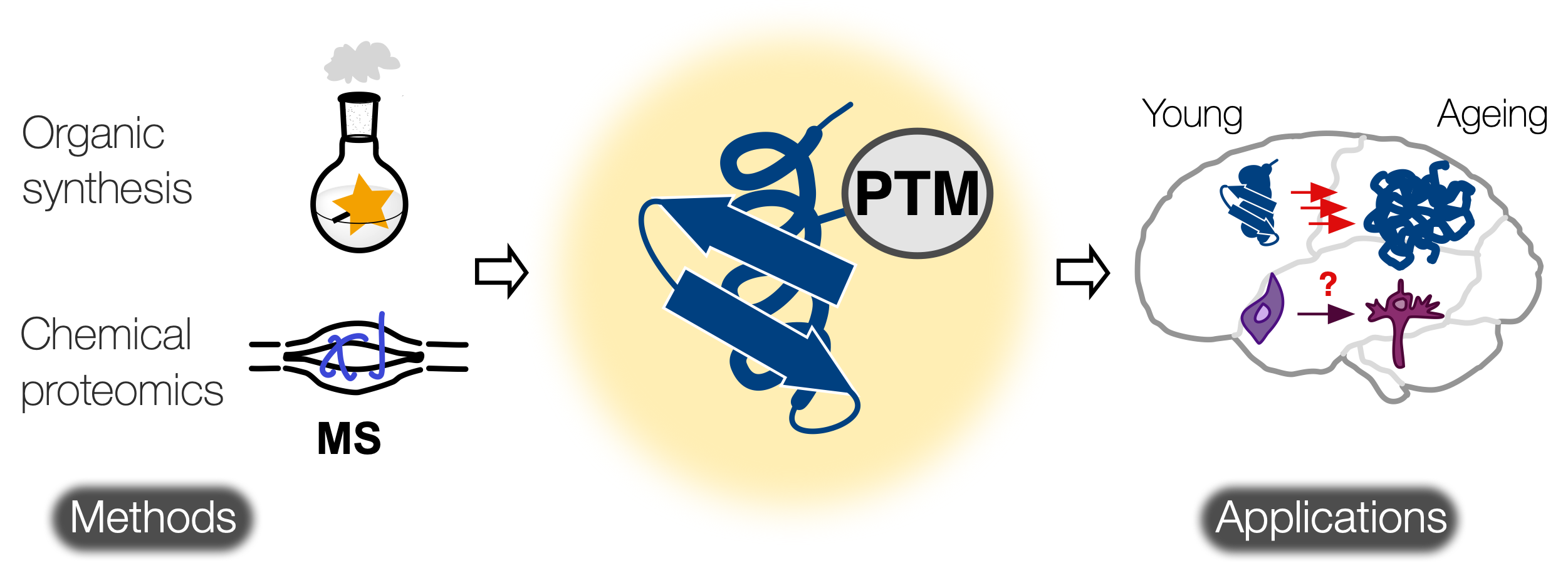
Tweaking protein post-translational modifications to tackle neurological diseases.
Protein post-translational modifications (PTMs) form a complex regulatory layer that controls protein activity. They allow cells to adjust their metabolism rapidly to a changing environment and thereby maintain cellular homeostasis. Many central processes in neurodevelopment and neurodegeneration are governed by protein PTMs.
Our research focuses on neurodegenerative diseases such as Alzheimer’s and Parkinson’s disease. Many of the PTM-controlled pathways that shape neuronal development and sustain neuronal health become dysregulated in the aging brain, so we map these PTMs and characterize their functions. Among the many known human PTMs, we concentrate on protein AMPylation and on microtubule modifications, the so-called tubulin code. We aim to identify PTM-based markers for early diagnosis and to discover proteins and PTMs whose modulation could reverse neurodegeneration. To this end, we develop chemical biology tools, chemical proteomics methods and mass spectrometry techniques.
Selected publications:
Abanti, R. R.; Wu, D.; Kielkowski, P.: "Cysteine reactive chloroalkane probe enables HaloTag ligation for downstream chemical proteomics analysis." RSC Chem. Biol., 2026, 7, 1018-1023. DOI: 10.1039/D6CB00004E.
Hoffmann, L.; Eckl, E.-M.; Bérouti, M.; Pries, M.; Koller, A.; Guhl, C.; Hellmich, U. A.; Hornung, V.; Xiang, W.; Jae, L. T.; Kielkowski, P.: "AMPylation regulates 5'-3' exonuclease PLD3 processing." Mol. Cell. Proteomics, 2025, DOI: 10.1016/j.mcpro.2025.101051.
Chen, H.; Zang, L.; Kielkowski, P.: "Self-assembled PROTACs enable glycoproteins degradation in the living cells." Chem. Sci., 2025, 16, 8060-8068. DOI: 10.1039/D5SC00400D.
Wiest, A.; Kielkowski, P.: "Cu-Catalyzed Azide−Alkyne−Thiol Reaction Forms Ubiquitous Background in Chemical Proteomic Studies." JACS, 2024, 3, 2151-2159. DOI: 10.1021/jacs.3c11780.
Makarov, D.; Kielkowski, P.: "Chemical proteomics reveals protein tyrosination beyond the alpha-tubulins in human cells." ChemBioChem, 2022, DOI: 10.1002/cbic.202200414.
Becker, T.; Wiest, A.; Telek, A.; Bejko, D.; Hoffman-Röder, A.; Kielkowski, P.: "Transforming chemical proteomics enrichment into high throughput method using SP2E workflow." JACS Au, 2022 DOI: 10.1021/jacsau.2c00284.
Becker, T.; Cappel, C.; Di Matteo, F.; Sonsalla, G.; Kaminska, E.; Spada, F.; Cappello, S.; Damme, M.; Kielkowski, P.: "AMPylation profiling during neuronal differentiation reveals extensive variation on lysosomal proteins." iScience, 2021, 24, 103521. DOI: 10.1016/j.isci.2021.103521.
Sieber, S. A.; Cappello, S.; Kielkowski, P.: "From young to old: AMPylation hits the brain." Cell Chem. Biol., 2020, 27, 773-779 (The Perspective highlighted on the Cover page).
Kielkowski, P.; Buchsbaum, I.; Kirsch, V.; Bach, N.; Drukker, M.; Cappello, S.; Sieber, S.: "FICD activity and AMPylation remodelling modulate human neurogenesis." Nat. Commun., 2020, 11, 517.